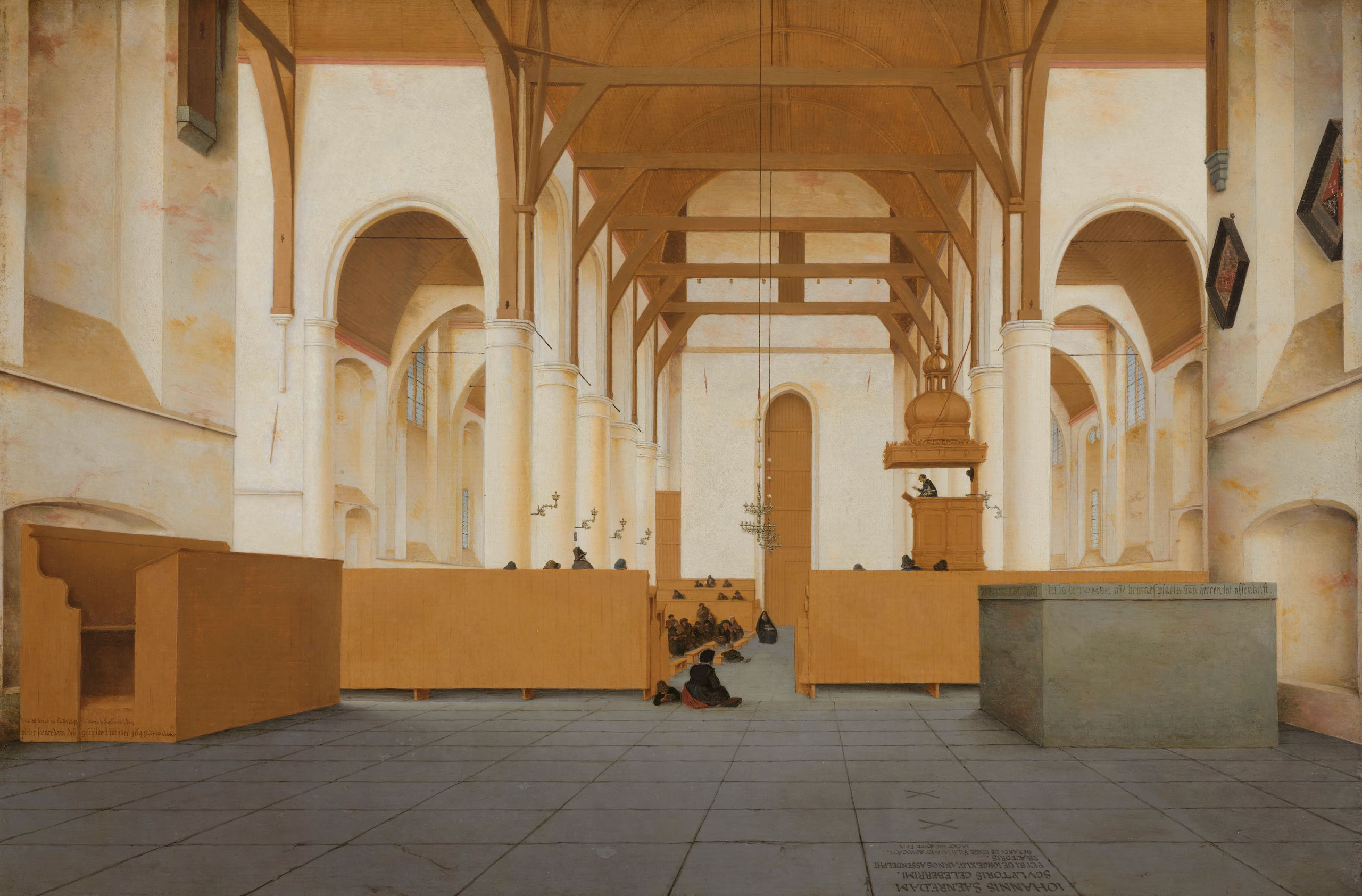
Pieter Saenredam's 1649 painting of the interior of the Sint-Odulphuskerk in Assendelft during a sermon.
Interior of the Sint-Odulphuskerk in Assendelft. 1649, Pieter Jansz. Saenredam; Rijksmuseum, Amsterdam. Public domain.

16th – 17th centuries

Reformation and Confessional

Lutheran chorale, metrical psalmody, Anglican hymnody, and Catholic devotional renewal.

Reformation and Confessional spans the 16th through 17th centuries of twenty-one.

1st century21st century

No recordings published yet

The congregation receives the hymnal, and every voice in the room becomes the choir.

The Reformation's most durable technology was the hymnal. In 1524 Luther published a book of eight songs; within a generation, congregational singing in the common language defined Protestant worship. The chorale put the whole confession into the mouths of the whole congregation.

Geneva answered with the Psalter of 1562, the Psalms metered and set for common voices, and the English-speaking church followed with psalm books of its own. Catholic reform produced its counterpart in Palestrina, polyphony ordered to the clarity of the sacred text.

The century that divided the Church multiplied its song. Paul Gerhardt's hymns, written amid war and plague in the 1600s, remain among the most sung texts in the whole tradition.

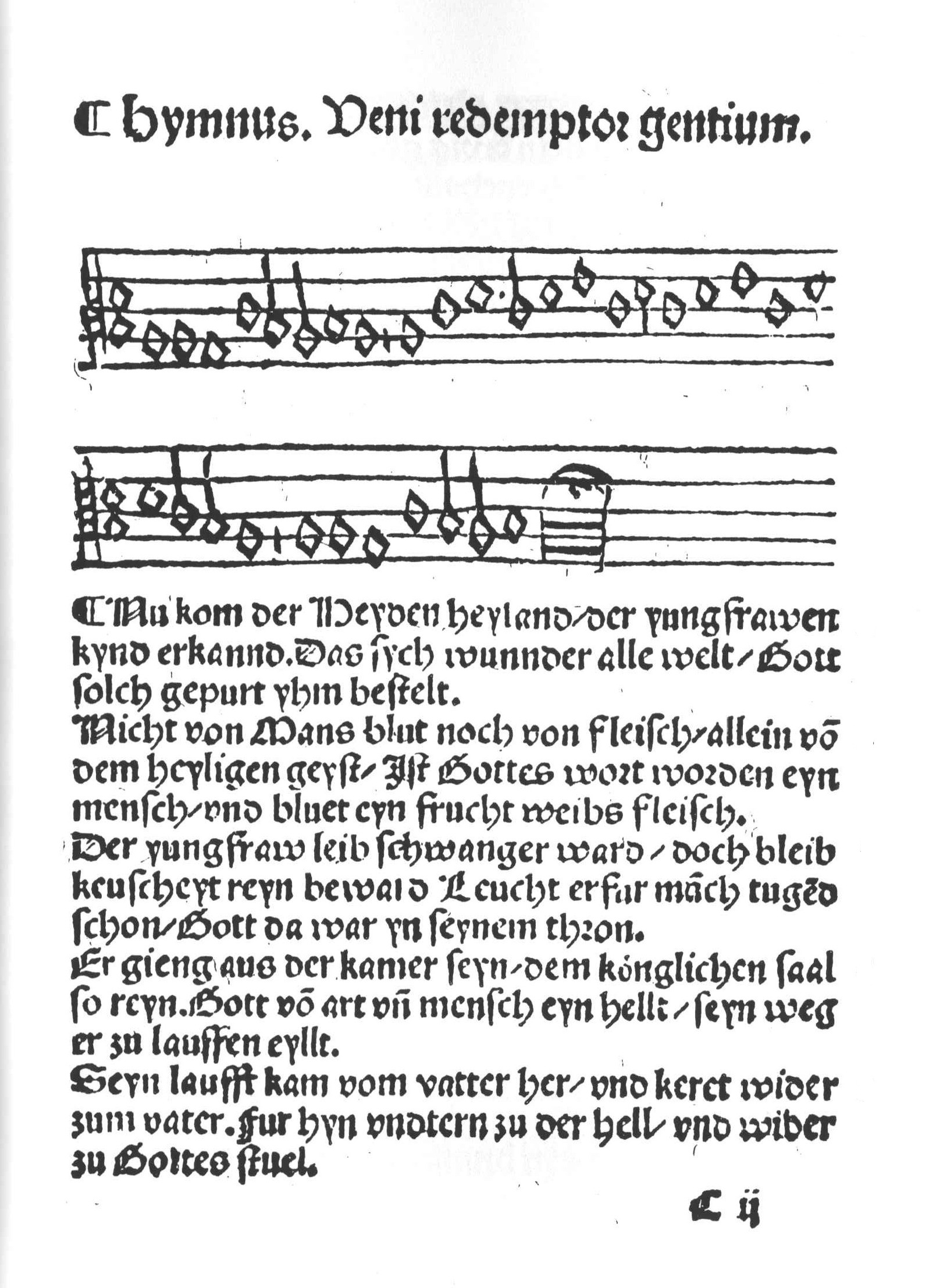
Nu kom der Heyden heyland / der yungfrawen kynd erkannd. Das sych wunnder alle welt / Gott solch gepurt yhm bestelt.

Martin Luther · Nu kom der Heyden heyland · Erfurt Enchiridion, 1524 · Wikisource diplomatic transcription

Later English (not Luther) · Leonard Woolsey Bacon, The Hymns of Martin Luther, 1883Saviour of the heathen, known / As the promised virgin’s Son; / Come thou wonder of the earth, / God ordained thee such a birth.

CIAN INTERPRETATIONA recasting of Ambrose, Veni redemptor gentium. This row is Luther’s German, not a 4th-c. witness. The 1524 Enchiridion page does not print a composer credit. Do not treat the melody as proven Luther. Player: a setting of Nun komm der Heiden Heiland. Not a claim that this is Luther’s own 1524 tune. NOT Ein feste Burg.

  1. 1549 ≠ 1662. The Collect is the 1549 English. Not 1552, not 1559, not 1662.
  2. The Nun komm object is the Erfurt Enchiridion 1524 leaf. Achtliederbuch is not this hymn’s first page.
  3. Bacon and Winkworth are later English, not Luther’s German and not Gerhardt’s.
  4. Calvin did not write the Genevan tunes. Bourgeois, Franc, and others; Marot and Bèze wrote the metres.
  5. Gerhardt did not write Hassler’s 1601 melody. Later Bach settings are out of era.
  6. Palestrina, a 1562 French psalm, Mogila, and Dositheos stay gaps. Do not invent them.
  7. No Watts, Wesley, or Bach. No Hippolytus. Do not write “hear them sing.”
  8. The 1549 Communion Creed’s “father and the sonne” is later Western Filioque, not 4th-c. Greek, and is not this page’s extract.

Stay — same hymn

SOURCE

Nicht von Mans blut noch von fleisch / allein von dem heyligen geyst / Ist Gottes wort worden eyn mensch / vnd bluet eyn frucht weibs fleisch.

Lob sey Gott dem vatter thon / Lob sey got seym eyngen son. Lob sey got dem heyligen geyst / ymer vnnd ynn ewigkeyt.

Luther · same 1524 Enchiridion · stanzas 2 and doxology

SOURCE

Not of flesh and blood the son, / Offspring of the Holy One, / Born of Mary ever-blest, / God in flesh is manifest.

Praise be to the Father done, / Praise be to the only Son, / Praises to the Spirit be, / Now and to eternity.

Later English (not Luther) · Leonard Woolsey Bacon, The Hymns of Martin Luther, 1883

Erfurt Enchiridion 1524 leaf (reprint-scan of the 1524 typesetting, Speyer 2008 facsimile; not a photograph of the Goslar unique). Heading Veni redemptor gentium; stanza Nu kom der Heyden heyland; sig. C ij.
  1. Augsburg, 1530

    SOURCE

    [1] Ecclesiae magno consensu apud nos docent, Decretum Nicenae Synodi de unitate essentiae divinae de tribus personis verum et sine ulla dubitatione credendum esse. [2] Videlicet, quod sit una essentia divina, quae et appellatur et est Deus, aeternus, incorporeus, impartibilis, immensa potentia, sapientia, bonitate, creator et conservator omnium rerum, visibilium et invisibilium, [3] et tamen tres sint personae, eiusdem essentiae, et potentiae, et coaeternae, Pater, Filius, et Spiritus sanctus. [4] Et nomine personae utuntur ea significatione, qua usi sunt in hac causa Scriptores Ecclesiastici, ut significet non partem aut qualitatem in alio, sed quod proprie subsistit.

    Our Churches, with common consent, do teach that the decree of the Council of Nicaea concerning the Unity of the Divine Essence and concerning the Three Persons, is true and to be believed without any doubting; that is to say, there is one Divine Essence which is called and which is God: eternal, without body, without parts, of infinite power, wisdom, and goodness, the Maker and Preserver of all things, visible and invisible; and yet there are three Persons, of the same essence and power, who also are coeternal, the Father, the Son, and the Holy Ghost. And the term “person” they use as the Fathers have used it, to signify, not a part or quality in another, but that which subsists of itself.

    Confessio Augustana, Art. I · Philipp Melanchthon, for the Lutheran estates · Latin: Concordia, Leipzig 1584, as printed · English: Triglot Concordia, Bente and Dau, 1921, from the Latin

    CIAN INTERPRETATIONNicaea is received, not rewritten. This is 1530, not 325, and not 381. German CA I was not fetched. No image.

  2. Calvin

    SOURCE

    As for public prayers, there are two kinds. The ones with the word alone: the others with singing. And this is not something invented a little time ago. For from the first origin of the Church, this has been so, as appears from the histories. And even St. Paul speaks not only of praying by mouth: but also of singing. And in truth we know by experience that singing has great force and vigor to move and inflame the hearts of men to invoke and praise God with a more vehement and ardent zeal. Care must always be taken that the song be neither light nor frivolous; but that it have weight and majesty (as St. Augustine says), and also, there is a great difference between music which one makes to entertain men at table and in their houses, and the Psalms which are sung in the Church in the presence of God and his angels.

    Therefore, when we have looked thoroughly, and searched here and there, we shall not find better songs nor more fitting for the purpose, than the Psalms of David, which the Holy Spirit spoke and made through him. And moreover, when we sing them, we are certain that God puts in our mouths these, as if he himself were singing in us to exalt his glory.

    John Calvin · Preface / Epistre au Lecteur · English from the 1565 Goudimel Pseaumes facsimile as printed on CCEL · French not fetched

    CIAN INTERPRETATIONHe did not compose the Genevan tunes. This is the why, not a Marot/Bèze stanza. No image. A 1562 psalm page was not downloaded. Do not invent one.

  3. BCP 1549

    SOURCE

    The Priest standing humbly afore the middes of the Altar, shall saie the Lordes praier, with this Collect.

    ALMIGHTIE God, unto whom all hartes bee open, and all desyres knowen, and from whom no secretes are hid: clense the thoughtes of our hartes, by the inspiracion of thy holy spirite: that we may perfectly love thee, and worthely magnifie thy holy name: through Christ our Lorde. Amen.

    Church of England · Collect at the opening of Holy Communion, 1549 · Whitchurche printing, as reprinted

    CIAN INTERPRETATIONNot 1662. The 1549 Communion Creed’s Filioque is later Western and is not this extract.

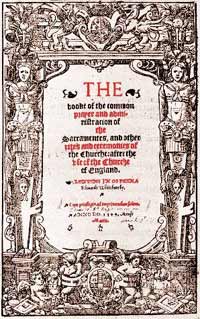
    Book of Common Prayer 1549 title page, Whitchurche printing
    1549 title page. The Collect stands on the next opening of that service. bcp-1549-title.jpg · Whitchurche printing, as reprinted.
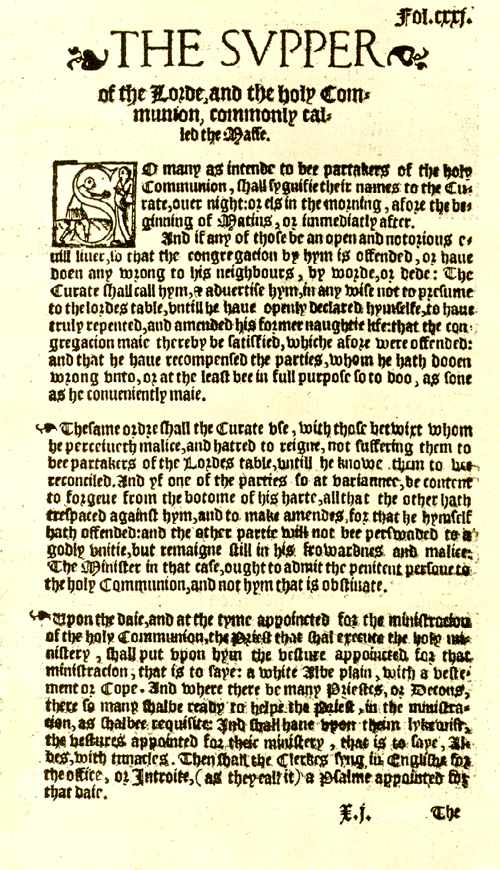
    First page of the 1549 Holy Communion, Book of Common Prayer
    Sister first page of the 1549 Holy Communion. The Collect stands on the next opening of that service. bcp-1549-communion-opening.jpg
  4. Trent, 1562

    SOURCE

    CHAPTER II. That the Sacrifice of the Mass is propitiatory both for the living and the dead. And forasmuch as, in this divine sacrifice which is celebrated in the mass, that same Christ is contained and immolated in an unbloody manner, who once offered Himself in a bloody manner on the altar of the cross; the holy Synod teaches, that this sacrifice is truly propritiatory and that by means thereof this is effected, that we obtain mercy, and find grace in seasonable aid, if we draw nigh unto God, contrite and penitent, with a sincere heart and upright faith, with fear and reverence. … For the victim is one and the same, the same now offering by the ministry of priests, who then offered Himself on the cross, the manner alone of offering being different.

    They shall also banish from churches all those kinds of music, in which, whether by the organ, or in the singing, there is mixed up any thing lascivious or impure; … that so the house of God may be seen to be, and may be called, truly a house of prayer.

    Council of Trent · Session XXII, 17 September 1562 · Waterworth 1848 · Hanover pages 154–155 and 161 as printed

    CIAN INTERPRETATION“Propritiatory” is Waterworth’s spelling on that scan. Palestrina is not the council’s composer and is not a room. No image.

  5. Heidelberg, 1563

    SOURCE

    Frage 1. Was ist dein einiger Trost im Leben und im Sterben? Antwort. Daß ich mit Leib und Seele, beides im Leben und im Sterben, nicht mein, sondern meines getreuen Heilandes Jesu Christi eigen bin, der mit seinem theuren Blute für alle meine Sünden vollkommen bezahlet, und mich aus aller Gewalt des Teufels erlöset hat; und also bewahret, daß ohne den Willen meines Vaters im Himmel kein Haar von meinem Haupte kann fallen, ja auch mir alles zu meiner Seligkeit dienen muß. Darum er mich auch durch seinen heiligen Geist des ewigen Lebens versichert, und ihm forthin zu leben von Herzen willig und bereit macht.

    Question 1. What is thy only comfort in life and in death? Answer. That I, with body and soul, both in life and in death, am not my own, but belong to my faithful Saviour Jesus Christ, who with his precious blood has fully satisfied for all my sins, and redeemed me from all the power of the devil; and so preserves me that without the will of my Father in heaven not a hair can fall from my head; yea, that all things must work together for my salvation. Wherefore, by his Holy Spirit, he also assures me of eternal life, and makes me heartily willing and ready henceforth to live unto him.

    Heidelberg Catechism · Lord’s Day 1, Q&A 1 · Schaff, Creeds of Christendom, vol. III

    CIAN INTERPRETATIONReceived 19th-c. German/English, not a 1563 diplomatic leaf. Q. 80 is a later 1563 insertion and is not this room. No image.

  6. Teresa

    SOURCE

    WHILE I was begging our Lord to-day to speak for me, since I knew not what to say nor how to commence this work which obedience has laid upon me, an idea occurred to me which I will explain, and which will serve as a foundation for that I am about to write.

    I thought of the soul as resembling a castle, formed of a single diamond or a very transparent crystal, and containing many rooms, just as in heaven there are many mansions.

    … As far as I can understand, the gate by which to enter this castle is prayer and meditation. I do not allude more to mental than to vocal prayer, for if it is prayer at all, the mind must take part in it. If a person neither considers to Whom he is addressing himself, what he asks, nor what he is who ventures to speak to God, although his lips may utter many words, I do not call it prayer.

    Teresa of Ávila · Interior Castle, First Mansions, ch. I · Stanbrook / Zimmerman · CCEL running pages 38–39, 43

    CIAN INTERPRETATIONSpanish was not loaded. Do not invent it. No 19th-c. portrait as her face. No image.

  7. John of the Cross

    SOURCE

    On a dark night, Kindled in love with yearnings—oh, happy chance!— I went forth without being observed, My house being now at rest.

    IN this first stanza the soul relates the way and manner which it followed in going forth, as to its affection, from itself and from all things, and in dying to them all and to itself, by means of true mortification, in order to attain to living the sweet and delectable life of love with God; and it says that this going forth from itself and from all things was a ‘dark night,’ by which, as will be explained hereafter, is here understood purgative contemplation, which causes passively in the soul the negation of itself and of all things referred to above.

    John of the Cross · Dark Night, Book I, Stanza the First + opening of the Exposition · E. Allison Peers from Silverio · CCEL

    CIAN INTERPRETATIONSpanish was not loaded. Do not invent it. No image.

  8. Francis de Sales

    SOURCE

    PRAYER opens the understanding to the brightness of Divine Light, and the will to the warmth of Heavenly Love—nothing can so effectually purify the mind from its many ignorances, or the will from its perverse affections. It is as a healing water which causes the roots of our good desires to send forth fresh shoots, which washes away the soul’s imperfections, and allays the thirst of passion.

    But especially I commend earnest mental prayer to you, more particularly such as bears upon the Life and Passion of our Lord. If you contemplate Him frequently in meditation, your whole soul will be filled with Him, you will grow in His Likeness, and your actions will be moulded on His. He is the Light of the world; therefore in Him, by Him, and for Him we shall be enlightened and illuminated; He is the Tree of Life, beneath the shadow of which we must find rest;—He is the Living Fountain of Jacob’s well, wherein we may wash away every stain.

    Francis de Sales · Introduction to the Devout Life, II.1 · CCEL printed pages 64–65 · translator unnamed on the fetched pages

    CIAN INTERPRETATIONEnglish is later, not 1609 French. Named substitute for Mogila / Dositheos, which did not load. No image.

  9. Herbert

    SOURCE

    LOve bade me welcome: yet my soul drew back, Guiltie of dust and sinne. But quick-ey’d Love, observing me grow slack From my first entrance in, Drew nearer to me, sweetly questioning, If I lack’d any thing. A guest, I answer’d, worthy to be here: Love said, You shall be he. I the unkinde, ungratefull? Ah my deare, I cannot look on thee. Love took my hand, and smiling did reply, Who made the eyes but I? Truth Lord, but I have marr’d them: let my shame Go where it doth deserve. And know you not, sayes Love, who bore the blame? My deare, then I will serve. You must sit down, sayes Love, and taste my meat: So I did sit and eat.

    George Herbert · Love · The Temple, 1633 · original spelling as printed on CCEL

    CIAN INTERPRETATIONThe “(III)” is later editorial. No 1633 title image this pass.

  10. Gerhardt

    SOURCE

    O Haupt voll Blut und Wunden, voll Schmerz und voller Hohn, o Haupt, zum Spott gebunden mit einer Dornenkron, o Haupt, sonst schön gezieret mit höchster Ehr und Zier, jetzt aber hoch schimpfieret: gegrüßet seist du mir!

    Erscheine mir zum Schilde, zum Trost in meinem Tod, und lass mich sehn dein Bilde in deiner Kreuzesnot. Da will ich nach dir blicken, da will ich glaubensvoll dich fest an mein Herz drücken. Wer so stirbt, der stirbt wohl.

    Paul Gerhardt · O Haupt voll Blut und Wunden · German as printed, labeled Crüger, Praxis Pietatis Melica, 1660 · the 1660 volume was not opened

    SOURCE

    Ah wounded Head! Must Thou / Endure such shame and scorn! / The blood is trickling from Thy brow / Pierced by the crown of thorn. / Thou who wast crowned on high / With light and majesty, / In deep dishonour here must die, / Yet here I welcome Thee!

    Come to me ere I die, / My comfort and my shield; / Then gazing on Thy cross can I / Calmly my spirit yield. / On Thee, when life is past, / My darkening eyes shall dwell, / My heart in faith shall hold Thee fast; / Who dieth thus, dies well.

    Later English (not Gerhardt) · Catherine Winkworth · Lyra Germanica, 1855 · CCEL running pages 84, 86

    CIAN INTERPRETATIONMelody: Hans Leo Hassler, 1601, Mein G’müt ist mir verwirret — not Gerhardt. “O Sacred Head, now wounded” is another later translation and is not quoted. Bach is closed. No image.

Named gaps. Not copy.

  • Palestrina — no named period print fetched. No invented score.
  • Genevan Psalter 1562, one French psalm — no named 1562 diplomatic page
  • Peter Mogila, Orthodox Confession; Dositheos of Jerusalem, Confession (1672) — not loaded
  • Ein feste Burg — not rowed (Nun komm used)
  • A hymn from the Achtliederbuch itself — not this hymn’s first page; the text was not extracted
  • Watts, Wesley, Bach — next era

Listen

Recordings from the 16th century

No recordings from the 16th century yet

Other centuries in this era may have recordings available.

Show all centuries

Traditions within this era

Lineages

  • Lutheran Chorale

    Sixteenth-century Wittenberg · Germany

    Congregational song in the vernacular, giving the whole people of God a musical voice in worship.

    German