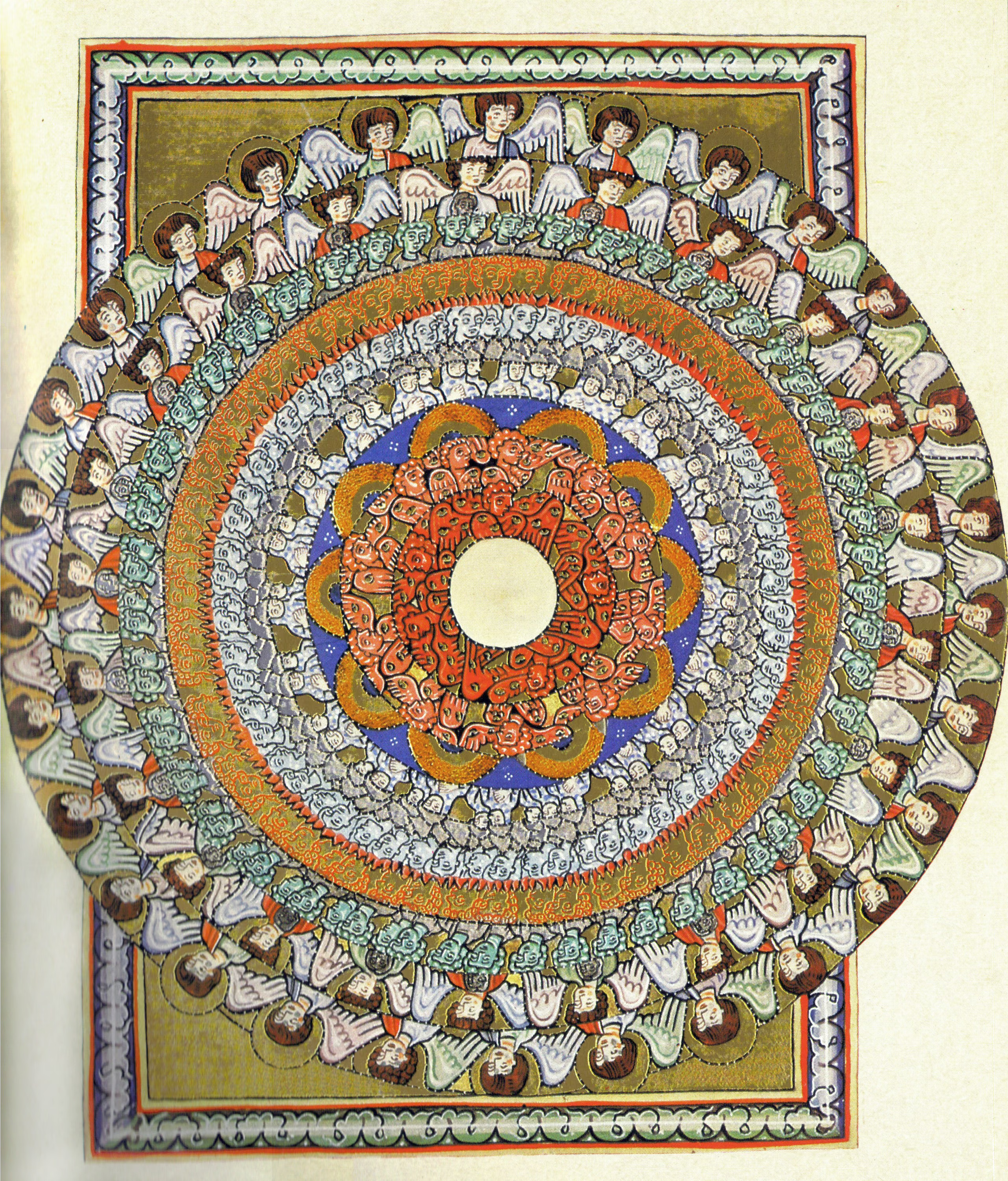
Twelfth-century illumination of the choirs of angels from Hildegard of Bingen's Scivias.
The Choirs of Angels. 12th century, Scivias of Hildegard of Bingen, Rupertsberg manuscript. Public domain.

8th – 15th centuries

Medieval and Monastic

Plainsong, monastic offices, Byzantine chant, mystical poetry, and early vernacular sacred song.

Medieval and Monastic spans the 8th through 15th centuries of twenty-one.

1st century21st century

No recordings published yet

Communities that kept the hours kept the music, for a thousand years.

For a thousand years the Church kept time by prayer. Monastic communities sang the entire Psalter every week, hour by hour through day and night, and that discipline preserved and refined the largest body of melody in the Western inheritance: plainchant.

This era invented the tools of written music. Neumes above the words became lines, the lines became a staff, and Guido of Arezzo gave singers the syllables still used to teach melody today. With notation came polyphony: at Notre-Dame in Paris, single chant lines opened into several voices at once.

Hildegard of Bingen heard her music as vision and wrote it down. Vernacular carols and Italian laude carried sacred song outside the cloister walls. By the era's end, ordinary believers were singing in their own languages about the mysteries the monasteries had guarded.

’Tis the Day of Resurrection: Earth! tell it out abroad! The Passover of gladness! The Passover of GOD! From Death to Life Eternal, -- From this world to the sky, Our CHRIST hath brought us over, With hymns of victory.

John of Damascus · Paschal Canon, Ode I · John Mason Neale, Hymns of the Eastern Church

Greek irmos as printedΑναστάσεως ημέρα λαμπρυνθώμεν Λαοί, Πάσχα Κυρίου, Πάσχα, εκ γάρ θανάτου πρός ζωήν, καί εκ γής πρός ουρανόν, Χριστός ο Θεός, ημάς διεβίβασεν, επινίκιον άδοντας.

CIAN INTERPRETATIONNeale is 19th-c. metrical. “Tell it out abroad” is Neale’s injection, not John’s Greek. The named hymn is band text beside the existing catalog player; this is not a claim that the live recording is Damascene’s own tune.

  1. No Gregory I melody. Gregorian is a later name.
  2. Damascene ≠ proven Octoechos arranger. Mar Saba traditional, not certain.
  3. No invented Notre-Dame organum.
  4. Aquinas Filioque doxology is later Western, not 4th-c. Greek. This hymn is not Fortunatus’s Pange lingua.
  5. No Slavonic, Armenian, Ge‘ez, or Coptic lines.
  6. Scivias hero is a lost original; prefer Riesencodex leaf.
  7. Do not write “we can hear them sing.” Neale is metrical and free. Draper’s All Creatures is not Francis.

Stay — same canon troparia

SOURCE

Our hearts be pure from evil, That we may see aright The LORD in rays eternal Of Resurrection-Light: And, listening to His accents, May hear, so calm and plain, His own -- All Hail! -- and hearing, May raise the victor strain!

Now let the Heav’ns be joyful! Let earth her song begin! Let the round world keep triumph, And all that is therein: Invisible and visible Their notes let all things blend, -- For CHRIST the LORD hath risen, -- Our joy that hath no end.

John of Damascus · Paschal Canon, Ode I troparia · John Mason Neale, Hymns of the Eastern Church
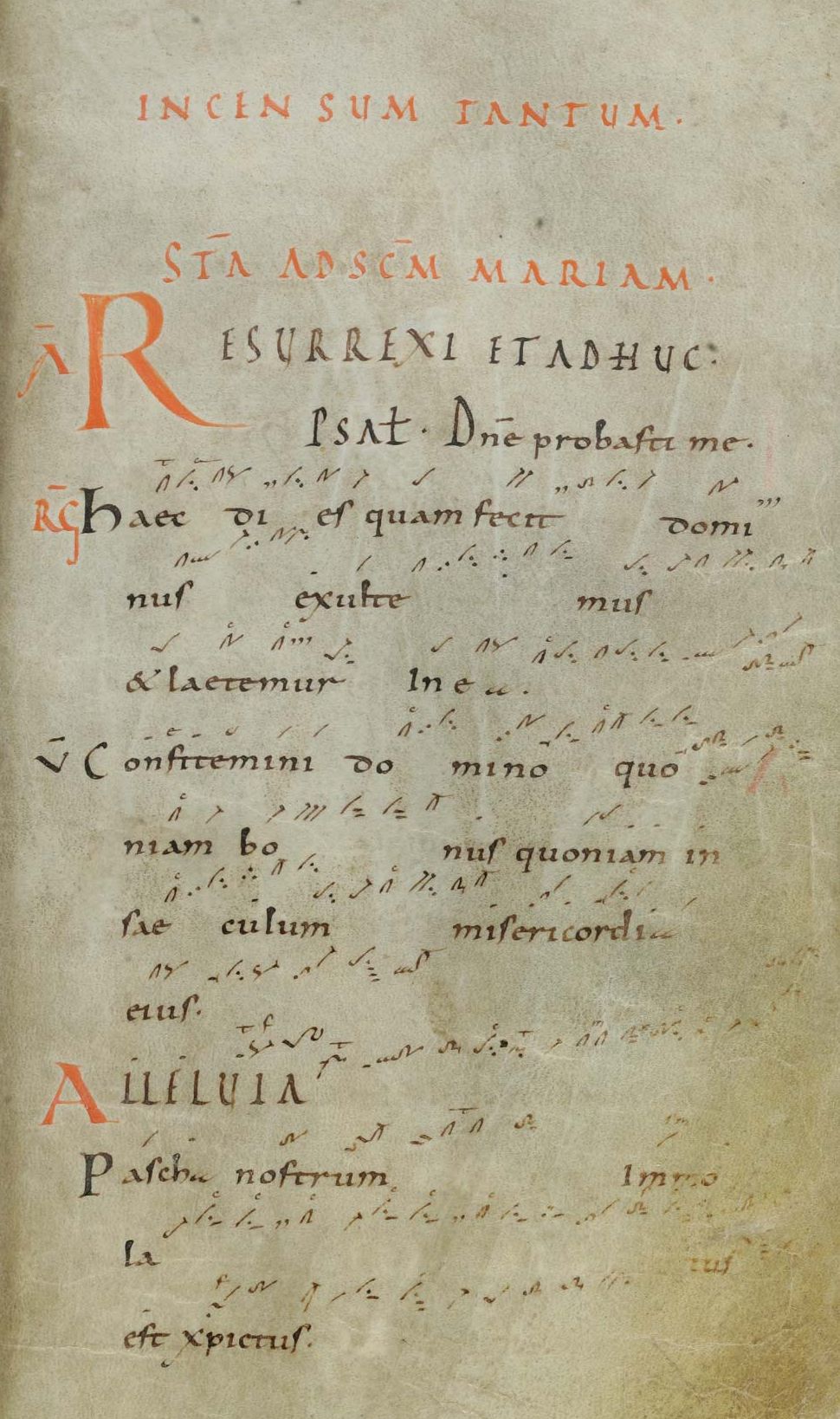
St. Gallen Cod. Sang. 359 p. 107, introit Resurrexi
A 10th-c. St. Gall neume leaf of the Western Resurrection introit. Not John’s Greek canon. Not his melody. A period object of written Paschal chant. Csg-0359_107.Resurrexi.jpg · St. Gallen Cod. Sang. 359 p. 107 introit Resurrexi · 922–925 · Commons PDM 1.0.
  1. Ut queant laxis

    SOURCE

    Ut queant laxīs resonāre fibrīs Mīra gestōrum famulī tuōrum, Solve pollūtī labiī reātum, Sāncte Iohannēs.

    So that they may, with loosened voices, resound the wonders of your deeds, clean the guilt from our stained lips, O Saint John.

    Hymnus in Ioannem · Latin as printed · English the same fetched page

    CIAN INTERPRETATIONText traditionally Paulus Diaconus, late 8th. Melody anonymous. Not a Gregory I tune.

  2. Guido

    SOURCE

    … exercitium musicae artis (pro quo, favente Deo, non incassum desudasse me memini) vestra iussit auctoritas proferri in publicum: ut sicut ecclesiam beatissimi Donati episcopi et martyris … mirabili nimium scemate peregistis, ita eiusdem ministros ecclesiae honestissimo decentissimoque quodam privilegio cunctis pene per orbem clericis spectabiles redderetis. … offero solertissimae paternitati vestrae Musicae artis regulas, quanto lucidius et brevius potui …

    Cum me et naturalis conditio et bonorum imitatio communis utilitatis diligentem faceret, coepi inter alia musicam pueris tradere. Tandem adfuit divina gratia, et quidam eorum imitatione cordae et nostrarum notarum usu exercitati, ante unius mensis spatium invisos et inauditos cantus ita primo intuitu indubitanter cantabant … Maxime itaque dolui de nostris cantoribus, qui etsi centum annis in canendi studio perseverent, numquam tamen vel minimam antiphonam per se valent efferre semper discentes, ut ait Apostolus, et numquam ad scientiam veritatis pervenientes (II Tim. III, 7).

    Guido of Arezzo · Micrologus, dedicatory letter + prologue · Latin Amelli 1904

    CIAN INTERPRETATIONLatin only; English is not invented here. ut–re–mi taught in Epistola ad Michahelem (not fetched). St. Gall Resurrexi may sit as sister labeled 10th-c. St. Gall, not Guido’s autograph.

    St. Gallen Cod. Sang. 359 p. 107, introit Resurrexi
    10th-c. St. Gall, not Guido’s autograph. Csg-0359_107.Resurrexi.jpg · St. Gallen Cod. Sang. 359 p. 107 introit Resurrexi · 922–925 · Commons PDM 1.0.
  3. Hildegard

    SOURCE

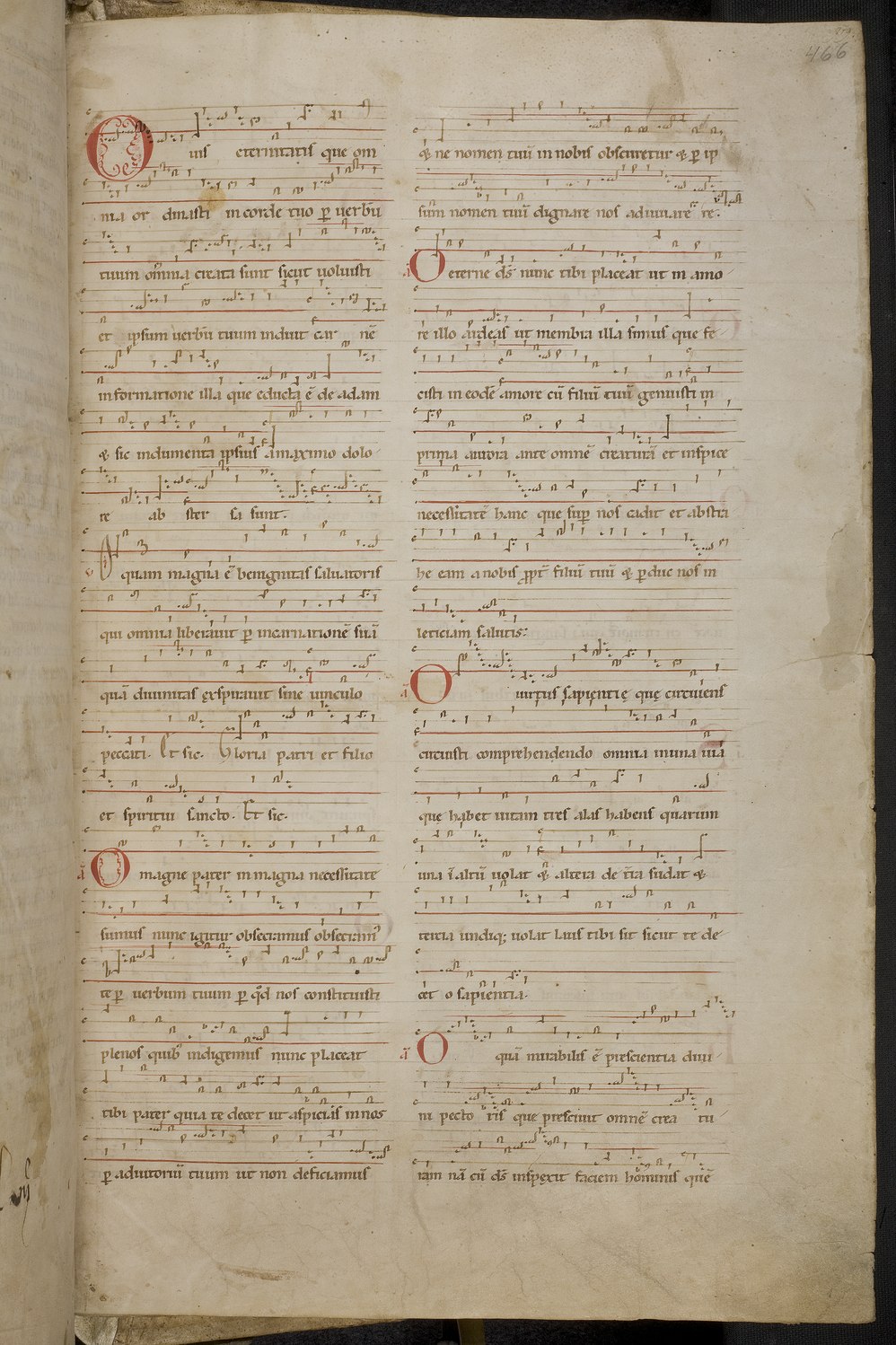
    O virtus Sapientie, que circuiens circuisti, comprehendendo omnia in una via que habet vitam, tres alas habens, quarum una in altum volat et altera de terra sudat et tercia undique volat. Laus tibi sit, sicut te decet, O Sapientia.

    O Wisdom’s energy! Whirling, you encircle and everything embrace in the single way of life. Three wings you have: one soars above into the heights, one from the earth exudes, and all about now flies the third. Praise be to you, as is your due, O Wisdom.

    Hildegard of Bingen · O virtus Sapientie · Latin as printed · English Nathaniel M. Campbell

    CIAN INTERPRETATION

    Three wings as Trinity is a reading of the image, not Hildegard’s title for the antiphon.

    Hildegard of Bingen · O virtus Sapientie · Latin as printed · English Nathaniel M. Campbell

    Riesencodex, Wiesbaden Hs. 2 fol. 466r
    The music folio itself. Prefer this over the live Scivias Choirs of Angels hero (lost Rupertsberg original, 1945). Riesencodex_-_fl.0466r.jpg · Wiesbaden Hs. 2 fol. 466r · 1175/1190 · Commons PDM 1.0.
  4. Francis

    SOURCE

    Altissimu, omnipotente bon Signore, Tue so le laude, la gloria e l'honore et onne benedictione. Ad Te solo, Altissimo, se konfano, et nullu homo ène dignu te mentouare. Laudato sie, mi Signore cum tucte le Tue creature, spetialmente messor lo frate Sole, lo qual è iorno, et allumini noi per lui. Et ellu è bellu e radiante cum grande splendore: de Te, Altissimo, porta significatione.

    Francis of Assisi · Canticle of the Creatures · Umbrian as commonly printed

    SOURCE

    The Highest, all powerful, good Lord, Yours are the praises, the glory, the honour, and all blessing. To You alone, The Highest, do they belong, and no man is worthy to mention Your name. Be praised, my Lord, through all your creatures, especially Sir Brother Sun, who brings the day; and you give light through him. And he is beautiful and radiant in all his splendour! Of you, The Highest, he bears the likeness.

    Francis of Assisi · Canticle of the Creatures · Franciscan TOR English

    CIAN INTERPRETATIONNot Draper’s All Creatures. Draper is not Francis.

  5. Aquinas

    SOURCE

    PANGE, lingua, gloriosi Corporis mysterium, Sanguinisque pretiosi, quem in mundi pretium fructus ventris generosi Rex effudit Gentium.

    Verbum caro, panem verum verbo carnem efficit: fitque sanguis Christi merum, et si sensus deficit, ad firmandum cor sincerum sola fides sufficit.

    Genitori, Genitoque laus et iubilatio, salus, honor, virtus quoque sit et benedictio: procedenti ab utroque compar sit laudatio. Amen. Alleluia.

    SING, my tongue, the Savior's glory, of His flesh the mystery sing; of the Blood, all price exceeding, shed by our immortal King, destined, for the world's redemption, from a noble womb to spring.

    Word-made-Flesh, the bread of nature by His word to Flesh He turns; wine into His Blood He changes;- what though sense no change discerns? Only be the heart in earnest, faith her lesson quickly learns.

    To the everlasting Father, and the Son who reigns on high, with the Holy Ghost proceeding forth from Each eternally, be salvation, honor, blessing, might and endless majesty. Amen. Alleluia.

    Thomas Aquinas · Pange lingua gloriosi corporis mysterium · Latin as printed · English Edward Caswall

    CIAN INTERPRETATIONNot Fortunatus’s Pange lingua. Last stanza procedenti ab utroque is later Western, not 4th-c. Greek.

  6. Palamas

    SOURCE

    Since the Son of God, in his incomparable love for man, did not only unite His divine Hypostasis with our nature, by clothing Himself in a living body and a soul gifted with intelligence …… but also united himself with the human hypostases themselves, in mingling himself with each of the faithful by communion with his Holy Body, and since he becomes one single body with us (cf. Eph. 3:6), and makes us a temple of the undivided Divinity, for in the very body of Christ dwells the fulness of the Godhead bodily (Col. 2:9), how should he not illuminate those who commune worthily with the divine ray of His Body which is within us, lightening their souls, as He illumined the very bodies of the disciples on Mount Tabor? … now, since it is mingled with us and exists in us, it illuminates the soul from within.

    Gregory Palamas · Triads I.3.38 · Gendle, Classics of Western Spirituality, 1983, p. 19

  7. Julian

    SOURCE

    AFTER this the Lord brought to my mind the longing that I had to Him afore. And I saw that nothing letted me but sin. … And thus, in my folly, afore this time often I wondered why by the great foreseeing wisdom of God the beginning of sin was not letted: for then, methought, all should have been well. …

    But Jesus, who in this Vision informed me of all that is needful to me, answered by this word and said: It behoved that there should be sin; but all shall be well, and all shall be well, and all manner of thing shall be well.

    … And for the tender love that our good Lord hath to all that shall be saved, He comforteth readily and sweetly, signifying thus: It is sooth that sin is cause of all this pain; but all shall be well, and all shall be well, and all manner [of] thing shall be well. These words were said full tenderly, showing no manner of blame to me nor to any that shall be saved.

    Julian of Norwich · Revelations of Divine Love, ch. 27 · Warrack 1901

    SOURCESynne is behovabil, but al shal be wel & al shal be wel & al manner of thyng shal be wele.

  8. The Cloud

    SOURCE

    For the first time you [lift your heart to God with stirrings of love], you will find only a darkness, and as it were a cloud of unknowing [...] Whatever you do, this darkness and the cloud are between you and your God, and hold you back from seeing him clearly by the light of understanding in your reason and from experiencing him in the sweetness of love in your feelings. [...] And so prepare to remain in this darkness as long as you can, always begging for him you love; for if you are ever to feel or see him...it must always be in this cloud and this darkness.

    By love may He be gotten and holden, but never through thought.

    The Cloud of Unknowing, ch. 3 · Spearing 2001 p. 22 · author unknown

    CIAN INTERPRETATIONAuthor unknown.

Named gaps. Not copy.

  • Notre-Dame / Léonin / Pérotin
  • Slavonic, Armenian, Ge‘ez, Coptic
  • Symeon
  • Italian laude
  • weekly Psalter Rule
  • Veni Creator, Dies Irae, Stabat Mater, Adoro te devote

Listen

Recordings

No recordings published yet

This era is documented but not yet recorded. The lineages below describe what it holds.

Traditions within this era

Lineages

  • Byzantine Chant

    Constantinople and the eastern Mediterranean · Byzantium

    The living chant tradition of the Orthodox Churches, developed through the octoechos and the great festal hymns.

    Greek, Church Slavonic