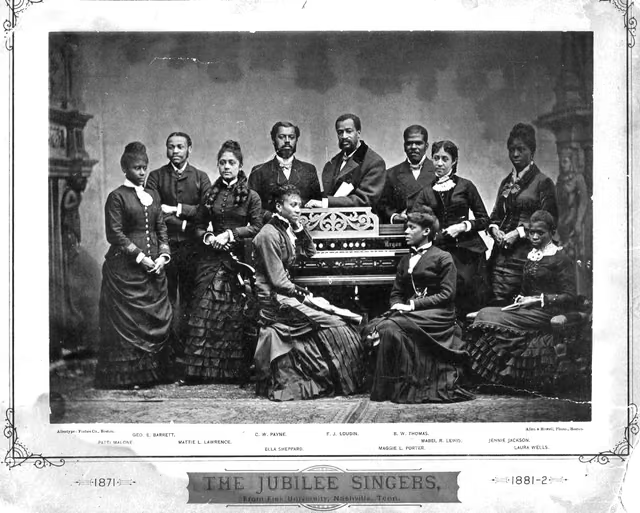
Photograph of the Fisk Jubilee Singers of Fisk University, 1882.
The Fisk Jubilee Singers. 1882, Fisk University, Nashville. Public domain.

18th – 19th centuries

Awakening, Mission, and Spirituals

Methodist hymnody, revival song, African American spirituals, and global missionary hymnody.

Awakening, Mission, and Spirituals spans the 18th through 19th centuries of twenty-one.

1st century21st century

No recordings published yet

Revival fields, mission ships, and the sorrow songs — the faith learns new voices.

Isaac Watts loosened English hymnody from strict psalm paraphrase, and Charles Wesley wrote several thousand hymns for a revival that sang before it preached. On the American frontier, camp meetings turned hymn singing into a mass, open-air practice.

Mission ships carried these songs to every continent, where they were translated and answered with new song. The era's deepest music, though, was born in bondage: the spirituals of enslaved African Americans — sorrow songs of exile and exodus, faith and defiance in one breath.

In 1871 the Fisk Jubilee Singers carried the spirituals from Nashville to the concert halls of America and Europe, and the world heard what the plantation had tried to silence.

When I survey the wond’rous Cross On which the Prince of Glory dy’d, My richest Gain I count but Loss, And pour Contempt on all my Pride. Forbid it, Lord, that I should boast, Save in the Death of Christ my God: All the vain Things that charm me most, I sacrifice them to his Blood. See from his Head, his Hands, his Feet, Sorrow and Love flow mingled down! Did e’er such Love and Sorrow meet, Or Thorns compose so rich a Crown? His dying Crimson, like a Robe, Spreads o’er his Body on the Tree; Then I am dead to all the Globe, And all the Globe is dead to me. Were the whole Realm of Nature mine, That were a Present far too small; Love so amazing, so divine, Demands my Soul, my Life, my All.

Isaac Watts · Crucifixion to the World by the Cross of Christ; Gal. 6.14 · 1709 wording as printed · Hymns and Spiritual Songs, Book III, prepared for the Lord’s Supper

CIAN INTERPRETATIONThis is the 1709 revision, not the 1707 first couplet. The 1709 book, on the fetched Hymnology Archive page, brackets stanza 4 as omissible in singing. Later “offering” for “Present” is not on this printing. Player: a setting of When I survey the wond’rous Cross. Not a claim that this is Watts’s own tune. Hamburg and Rockingham are later.

  1. Watts 1707 ≠ 1709. “Where the young Prince of Glory dy’d” is 1707. “On which the Prince of Glory dy’d” is Watts’s own 1709 change. Later “offering” for “Present” is not on the fetched 1709 printing.
  2. John Wesley is not the poet of Charles’s hymns. 1739 is a joint collection. John edited. Charles wrote Free Grace and the Christmas hymn.
  3. “Hark the herald angels sing” is not Wesley’s 1739 first line. This page prints “Hark how all the welkin rings.” Whitefield 1753 made the familiar change.
  4. Amazing Grace 1779 is six stanzas. “When we’ve been there ten thousand years” is later. It is not on the 1779-basis page.
  5. Spirituals: collector ≠ author. Allen, Ware, Garrison transcribed. Do not invent a plantation poet. Swing Low is not in the 1867 book and is not on this page.
  6. Underground Railroad is not SOURCE. Not on the 1867 pages for Roll, Jordan or Michael row. Later interpretation only, not a claim those pages make.
  7. Fisk 1871 tour ≠ 1872 book text. The 1876 London photograph is a period object, not a score. No invented 1872 lyric. Do not write “hear the Jubilee Singers.”
  8. No Zinzendorf German. No Tamil, Yoruba, or other mission-language edition loaded. Heber English is the missionary-era row, not a substitute original.
  9. Heber 1827 is not a 4th-c. Sanctus. NICAEA the tune is 1861 and is named for 325. Do not print 381 as 325. No Filioque as 4th-c. Greek.
  10. Do not write “we can hear them sing.” Hamburg, Rockingham, Sagina, Mendelssohn, and New Britain are later tunes.

Stay — 1707 first couplet (1707 flag)

SOURCE

When I survey the wondrous Cross Where the young Prince of Glory dy’d…

Isaac Watts · same hymn · 1707 first couplet as printed by Hymnology Archive and the Canterbury Dictionary of Hymnology

CIAN INTERPRETATIONWatts himself changed the second line for 1709. Both lines are Watts. Do not treat the 1709 wording as a later hymnal rewrite, and do not print the 1707 couplet as if it were the 1709 extract. No Watts title image.
  1. Charles Wesley, Free Grace

    SOURCE

    And can it be, that I should gain An int’rest in the Saviour’s blood! Died he for me?—Who caused his pain! For me?—Who him to death pursued. Amazing love! How can it be That thou, my God, shouldst die for me? ’Tis myst’ry all! Th’ immortal dies! Who can explore his strange design? In vain the first-born seraph tries To sound the depths of love divine. ’Tis mercy all! Let earth adore; Let angel minds enquire no more. He left his Father’s throne above, (So free, so infinite his grace!) Emptied himself of all but love, And bled for Adam’s helpless race: ’Tis mercy all, immense and free! For O my God! It found out me!

    Charles Wesley · Free Grace · Hymns and Sacred Poems, London: Strahan, 1739 · Duke CSWT modernized text of the 1739 Charles Wesley verse

    CIAN INTERPRETATIONCharles is the received poet. John Wesley collected and edited the 1739 book. He is not the poet of this hymn. The fetched file is labeled “Modernized text.” Do not treat it as a photograph of the 1739 leaf. Stanzas 4–6 continue on the same Duke page (imprisoned spirit; chains fell off; no condemnation; claim the crown through Christ). Shortened here as the dossier shortened them. Sagina is a later tune (Campbell, 1825). No 1739 title image.

  2. Charles Wesley, Hymn for Christmas Day

    SOURCE

    Hark how all the welkin rings “Glory to the King of kings, Peace on earth, and mercy mild, God and sinners reconciled!” Joyful all ye nations rise, Join the triumph of the skies, Universal nature say “Christ the Lord is born today!” Christ, by highest heav’n adored, Christ, the everlasting Lord, Late in time behold him come, Offspring of a virgin’s womb. Veiled in flesh, the Godhead see, Hail th’ incarnate deity! Pleased as man with men t’ appear Jesus, our Immanuel here!

    Charles Wesley · Hymn for Christmas Day · Hymns and Sacred Poems, 1739, pp. 206–8 in the Duke table · Duke CSWT modernized text

    CIAN INTERPRETATIONThe 1739 first line is welkin, the vault of heaven. Whitefield’s 1753 Hymns for Social Worship changed the opening to “Hark! The herald angels sing / Glory to the newborn King!” That 1753 form is not Wesley’s 1739 first line. Mendelssohn/Cummings pairings are later still. No 1739 Christmas page image.

  3. Newton, Faith’s Review and Expectation

    SOURCE

    Amazing grace! (how sweet the sound) That saved a wretch like me! I once was lost, but now am found, Was blind, but now I see. ’Twas grace that taught my heart to fear, And grace my fears relieved; How precious did that grace appear, The hour I first believed! Through many dangers, toils and snares, I have already come; ’Tis grace has brought me safe thus far, And grace will lead me home. The LORD has promised good to me, His word my hope secures; He will my shield and portion be, As long as life endures. Yes, when this flesh and heart shall fail, And mortal life shall cease, I shall possess, within the veil, A life of joy and peace. The earth shall soon dissolve like snow, The sun forbear to shine; But GOD, who called me here below, Will be for ever mine.

    John Newton · Faith’s Review and Expectation / Amazing Grace · Olney Hymns, Book I, Hymn 41 · CCEL text, print basis London: W. Oliver, 1779 · headed 1 Chr 17:16,17

    CIAN INTERPRETATIONSix stanzas. This is the 1779 poem. “When we’ve been there ten thousand years” is not on this page. New Britain is a later pairing (Walker, Southern Harmony, 1835 — not opened).

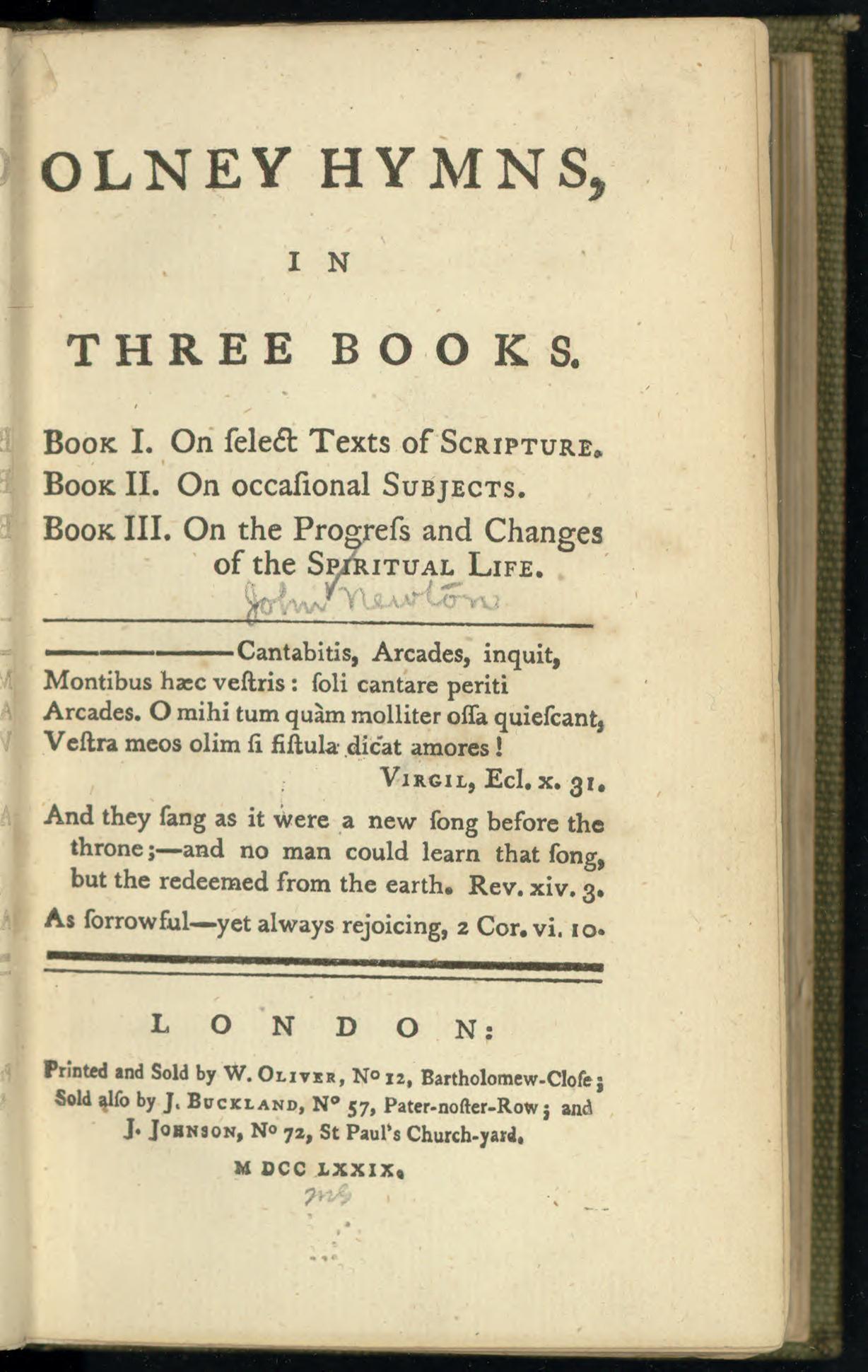
    Olney Hymns, in Three Books title page, London: W. Oliver, 1779
    Olney Hymns, in Three Books title · London: W. Oliver, Bartholomew-Close; Buckland; Johnson · MDCCLXXIX. The title, not the Hymn 41 leaf. Epigraphs on the title: Virgil, Ecl. x.31; Rev. xiv. 3; 2 Cor. vi. 10. Those are book epigraphs, not this hymn’s lemma. olney-hymns-1779-title.jpg · Library of Congress, item 2006700069.
  4. Cowper, Light shining out of darkness

    SOURCE

    God moves in a mysterious way, His wonders to perform; He plants his footsteps in the sea, And rides upon the storm. Deep in unfathomable mines Of never failing skill He treasures up his bright designs, And works his sovereign will. Ye fearful saints fresh courage take, The clouds ye so much dread Are big with mercy, and shall break In blessings on your head. Judge not the LORD by feeble sense, But trust him for his grace; Behind a frowning providence, He hides a smiling face. His purposes will ripen fast, Unfolding every hour; The bud may have a bitter taste, But sweet will be the flow’r. Blind unbelief is sure to err, And scan his work in vain; GOD is his own interpreter, And he will make it plain.

    William Cowper · Light shining out of darkness · Olney Hymns, Book III, Hymn 15 · CCEL, same 1779 print basis

    CIAN INTERPRETATIONCowper’s hymns in that book are the ones Newton marked C. A stray “Jn 8:7” sat beside “Blind unbelief” on the fetched HTML. That looks like site markup, not a lemma Cowper printed. Not treated as Cowper’s citation. Same 1779 Olney title as the Newton room. Not a Cowper portrait.

    Olney Hymns, in Three Books title page, London: W. Oliver, 1779
    Same 1779 Olney title as the Newton room. Not a Cowper portrait. olney-hymns-1779-title.jpg · Library of Congress, item 2006700069.
  5. Camp-meeting, Hymn 379

    SOURCE

    Camp-meetings with thy presence crown, And show’t O Lord, they blessings down; Fill every heard with holy zeal, And all thy righteousness reveal, O’er all our hosts do thou preside, And all our various movements guide; The praying companies attend, And show thyself the sinner’s friend. Pour cut the Spirit on thy sons, And visit thy anointed ones; May every virgin trim her lamp, And glory rest upon our camp. May prayer and praise united rise Like holy incense to the skies; In all our hosts display thy power! May souls be born again this hour!

    Anonymous in the fetched cataloging · Hymn 379, L.M. · The Camp-Meeting Chorister, Philadelphia: J. Clarke, 1830 · Teach US History transcription of the American Antiquarian Society copy

    CIAN INTERPRETATIONOCR slips on the fetched page (“show’t” / “they blessings” / “heard” / “Pour cut”) are left standing. The 1830 leaf itself was not opened. Not a generated frontier voice. “Trim her lamp” is diction, not a cited verse. No 1830 title image.

  6. Roll, Jordan, roll

    SOURCE

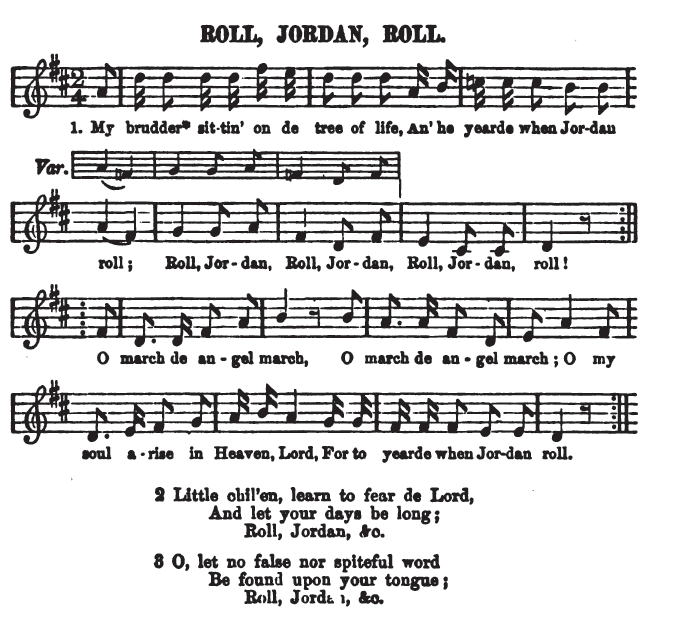
    1. My brudder sittin’ on de tree of life, An’ he yearde when Jordan roll; Roll, Jordan, Roll, Jordan, Roll, Jordan, roll! O march de angel march, O march de angel march; O my soul arise in Heaven, Lord, For to yearde when Jordan roll. 2. Little chil’en, learn to fear de Lord, And let your days be long; Roll, Jordan, &c. 3. O, let no false nor spiteful word Be found upon your tongue; Roll, Jordan, &c.

    Anonymous / “as sung” · Roll, Jordan, roll · Slave Songs of the United States, No. 1 · New York: A. Simpson & Co., 1867 · collected C. P. Ware, Port Royal Islands; variation L. McKim Garrison · DocSouth electronic edition, p. 1

    CIAN INTERPRETATIONThe collectors transcribed. They did not write the song. The 1867 page does not claim a coded escape meaning. Underground Railroad reading is later interpretation, not SOURCE. Swing Low is not in this book. Footnote: names may be substituted (“Parson Fuller, Deacon Henshaw, Brudder Mosey, Massa Linkum, &c.”). Editors’ bracket: “This spiritual probably extends from South Carolina to Florida, and is one of the best known and noblest of the songs.”

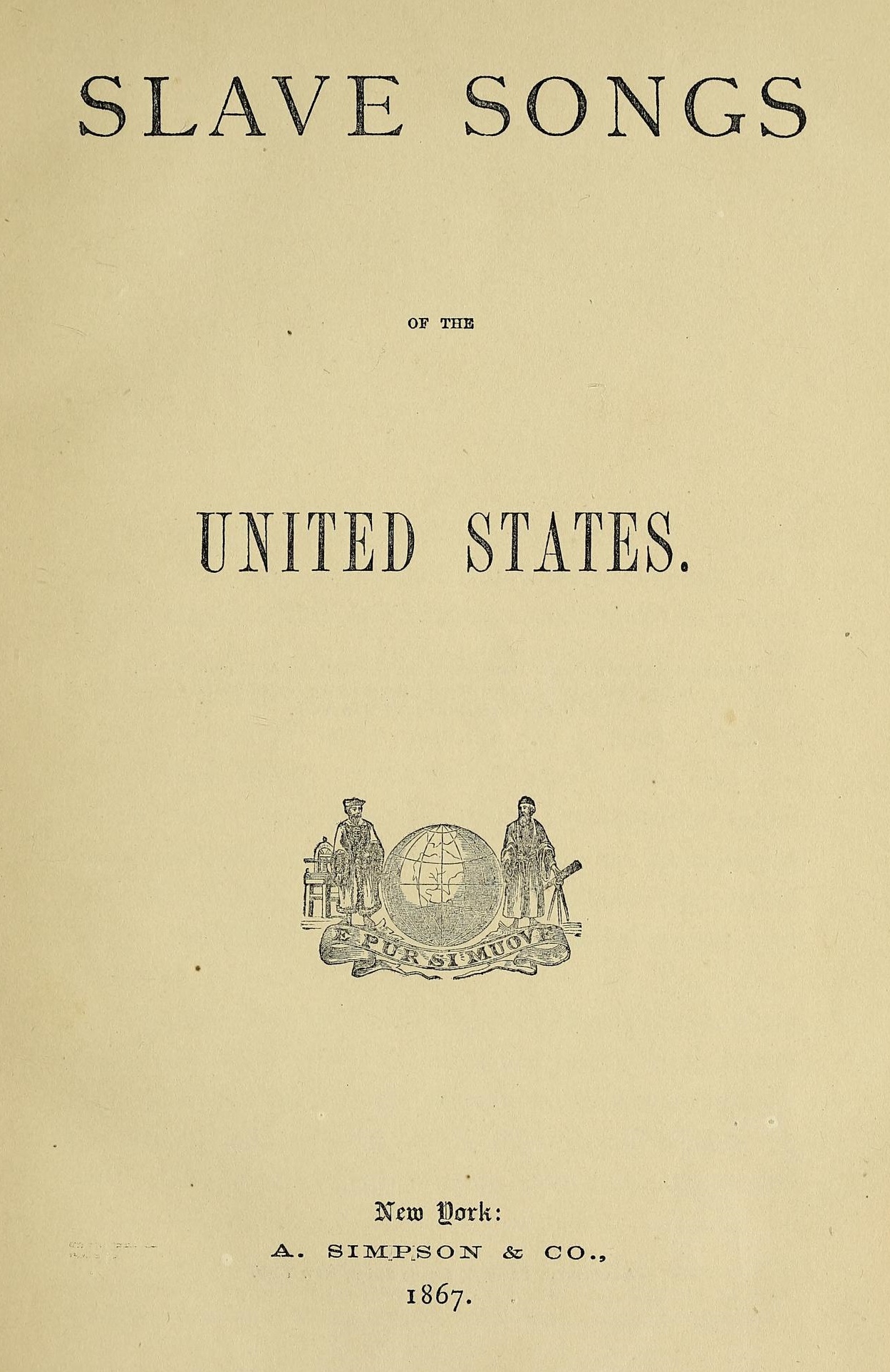
    Slave Songs of the United States title page, New York: A. Simpson & Co., 1867
    Slave Songs of the United States title · New York: A. Simpson & Co., 1867. The exact 1867 book. slave-songs-1867-title.jpg · Commons.
    Printed ROLL, JORDAN, ROLL. staves and three stanzas, Slave Songs of the United States, 1867
    Printed ROLL, JORDAN, ROLL. staves and three stanzas from the same 1867 book. Do not use the Commons file-page’s “p. 89” or “Charles Wesley” note; those are not on the printed leaf. roll-jordan-1867.png · Commons.
  7. Michael row the boat ashore

    SOURCE

    1. Michael row de boat ashore, Hallelujah! 2. Michael boat a gospel boat, Hallelujah! 3 I wonder where my mudder deh (there). 4 See my mudder on de rock gwine home. 5 On de rock gwine home in Jesus’ name. 6 Michael boat a music boat. 7 Gabriel blow de trumpet horn. 8 O you mind your boastin’ talk. 9 Boastin’ talk will sink your soul. 10 Brudder, lend a helpin’ hand. 11 Sister, help for trim dat boat. 12 Jordan stream is wide and deep. 13 Jesus stand on t’ oder side.

    Anonymous / “as sung” · Michael row the boat ashore · Slave Songs of the United States, No. 31 · 1867 · collected C. P. Ware, Port Royal Islands · DocSouth, pp. 23–24

    CIAN INTERPRETATIONAllen’s preface on the same book: “I know only one pure boat-song, the fine lyric, ‘Michael row the boat ashore’ (No. 31); and this I have no doubt is a real spiritual—it being the archangel Michael that is addressed.” Underground Railroad is not on this page. Swing Low is still not here. Same 1867 title as the Jordan room. A Commons Michael Row leaf exists and was not downloaded this pass.

    Slave Songs of the United States title page, New York: A. Simpson & Co., 1867
    Same 1867 title as the Jordan room. A Commons Michael Row leaf exists and was not downloaded this pass. slave-songs-1867-title.jpg · Commons.
  8. Heber, Holy, Holy, Holy

    SOURCE

    Holy, Holy, Holy! Lord God Almighty! Early in the morning our song shall rise to Thee; Holy, Holy, Holy! Merciful and Mighty! God in Three Persons, blessed Trinity! Holy, Holy, Holy! All the saints adore Thee, Casting down their golden crowns around the glassy sea; Cherubim and seraphim falling down before Thee, Which wert, and art, and evermore shalt be. Holy, Holy, Holy! though the darkness hide Thee, Though the eye of sinful man, thy glory may not see: Only Thou art holy, there is none beside Thee, Perfect in power in love, and purity. Holy, holy, holy! Lord God Almighty! All thy works shall praise thy name in earth, and sky, and sea; Holy, Holy, Holy! merciful and mighty, God in Three Persons, blessed Trinity!

    Reginald Heber · Holy, Holy, Holy! Lord God Almighty! · posthumous print, Hymns Written and Adapted to the Weekly Church Service of the Year, London: J. Murray, 1827, as printed on the fetched Wikipedia page

    CIAN INTERPRETATIONThe 1827 leaf was not independently opened. Hymnology Archive notes the 1826 Banbury book is “apparently lost.” NICAEA (Dykes, 1861) is a later tune, named for the council of 325. This is 19th-c. Anglican English, not a 4th-c. Greek witness. No Filioque as 4th-c. Greek. Heber later served in India; that biography is not a sentence in the lyric. No 1827 title image.

  9. Wheatley, On being brought from Africa to America

    SOURCE

    ’Twas mercy brought me from my Pagan land, Taught my benighted soul to understand That there’s a God, that there’s a Saviour too: Once I redemption neither sought nor knew. Some view our sable race with scornful eye, “Their colour is a diabolic die.” Remember, Christians, Negros, black as Cain, May be refin’d, and join th’ angelic train.

    Phillis Wheatley · On being brought from Africa to America · Poems on Various Subjects, Religious and Moral, London, 1773 as the conventional first book · this extract: Poetry Foundation printing

    CIAN INTERPRETATIONThe 1773 leaf was not opened. Do not invent a 1773 page number. The poem’s own words — mercy, pagan land, Saviour, Cain — are hers, not an atlas sermon. No 1773 title image.

  10. Fisk Jubilee Singers, 1876

    CIAN INTERPRETATIONNot a tenth extract. Not a lyric. No invented concert program. Do not write “hear the Jubilee Singers.”

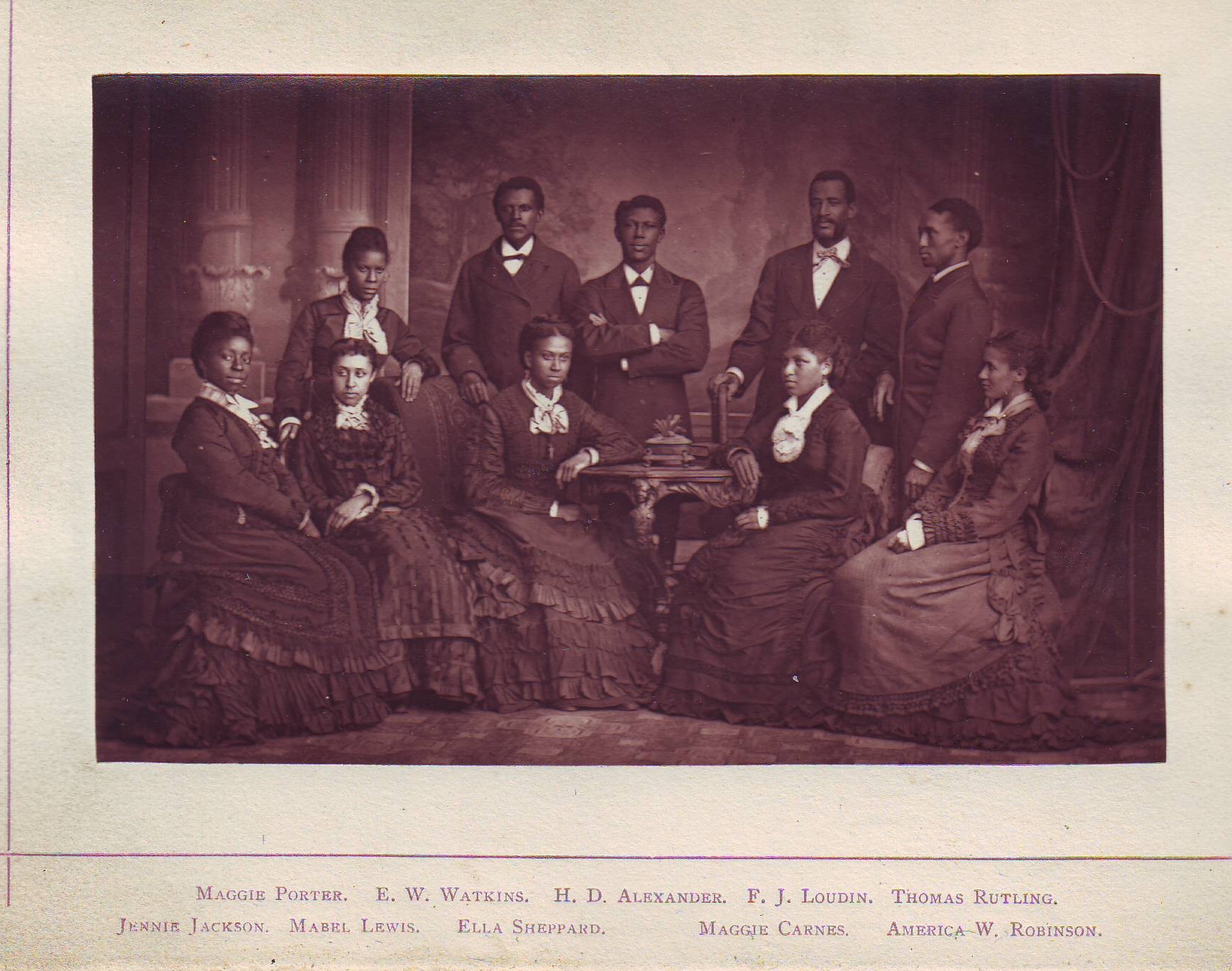
    Fisk Jubilee Singers, London studio photograph, 1876
    Fisk Jubilee Singers · London studio photograph, 1876 · names on the mount: Maggie Porter, E. W. Watkins, H. D. Alexander, F. J. Loudin, Thomas Rutling, Jennie Jackson, Mabel Lewis, Ella Sheppard, Maggie Carnes, America W. Robinson. A period photograph is a period object. This is 1876, not the 1871 departure portrait, and not the 1872 Jubilee Songs book. The 1871 tour remains site history, not a text source. fisk-jubilee-singers-1876.jpg · Commons.

Named gaps. Not copy.

  • Zinzendorf German — German running text did not load. Moravian German is a hole.
  • Fisk Jubilee Songs 1872 running text — identified, not opened. Swing Low is not invented.
  • Watts 1707/1709 title leaves; Watts Psalms 1719 Jesus shall reign; 1780 Methodist Collection; Toplady Rock of Ages; Fanny Crosby; Neale 19th-c. English of ancient hymns; Bach 18th-c. Lutheran; non-English mission hymn; Theophan; 1867 Nobody knows / Fisk Steal Away; Wheatley 1773 leaf; 1830 Camp-Meeting Chorister title photograph.

Listen

Recordings from the 19th century

No recordings from the 19th century yet

Other centuries in this era may have recordings available.

Show all centuries

Traditions within this era

Lineages

  • African American Spiritual

    Nineteenth-century United States · North America

    The spirituals are the singular musical inheritance of enslaved and freed African Americans — a lineage of lament, hope, resurrection, and coded freedom.

    English

  • Methodist Hymnody

    Eighteenth-century England · British Isles

    The Wesleyan lineage — deeply Trinitarian, biblically dense, and sung by a whole revival movement.

    English