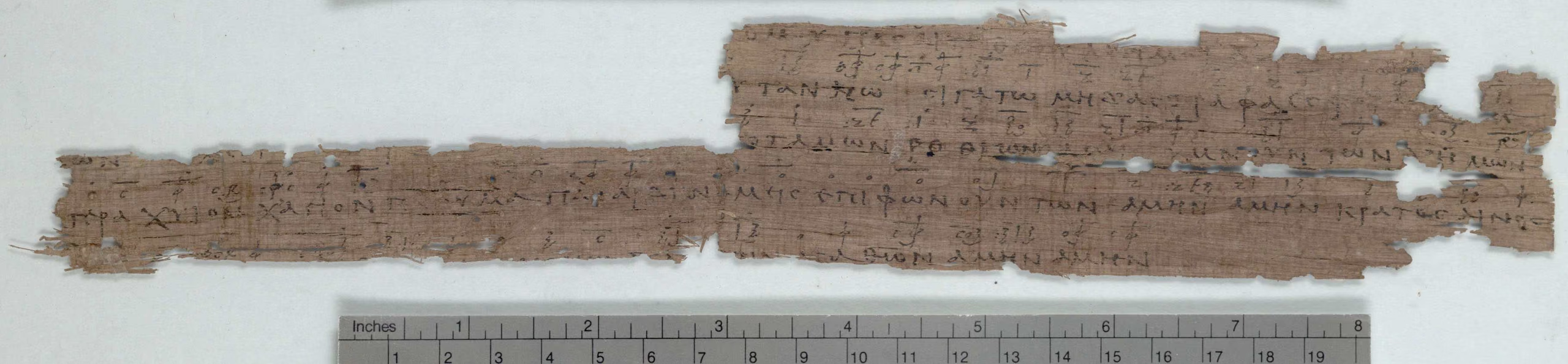
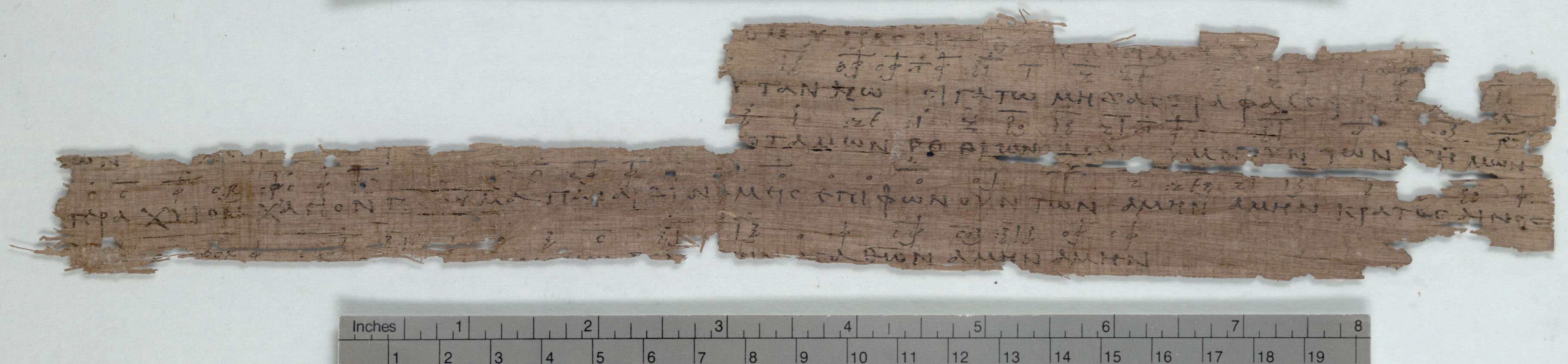
The Oxyrhynchus Hymn. Late 3rd century, Oxyrhynchus, Egypt; Bodleian Art, Archaeology and Ancient World Library, Oxford. Public domain.
1st – 3rd centuries
ApostolicandEarlyChurch
New Testament canticles, earliest Christological hymns, and Paschal fragments in Greek and Syriac.
Apostolic and Early Church spans the 1st through 3rd centuries of twenty-one.
1st century21st century
No recordings published yet
The first centuries left texts. The recordings on this page are living, not a claim that we can hear those rooms.
The Church was born singing. The first believers met in houses, and their worship carried the Psalms of Israel into a new confession: Jesus is Lord. Fragments of their earliest hymns survive inside the New Testament itself, in Philippians, in Colossians, in the songs of Revelation.
Outside witnesses noticed the music before they understood the faith. Around the year 112, the Roman governor Pliny reported to the emperor that Christians gathered before dawn and sang to Christ as to a god. That report, written to justify their prosecution, is one of the oldest descriptions of Christian worship we possess.
From these centuries come the oldest treasures in this collection: the lamp-lighting hymn Phos Hilaron, still sung at evening prayer across the world, and the Oxyrhynchus papyrus, the earliest Christian hymn preserved with its melody. Worship in this era was often dangerous and never silent.
Φῶς ἱλαρόν · anonymous · Greek, as commonly printed · later attestation: Basil, 4th c.
Φῶς ἱλαρόν · anonymous · Greek, as commonly printed · later attestation: Basil, 4th c.
SOURCEI give glory to Jesus Christ the God who bestowed such wisdom upon you.
Ignatius of Antioch · To the Smyrnaeans 1 · Lightfoot & Harmer 1891 (middle recension)
The letter
SOURCE
…fully persuaded as touching our Lord that He is truly of the race of David according to the flesh, but Son of God by the Divine will and power, truly born of a virgin…
They abstain from eucharist (thanksgiving) and prayer, because they allow not that the eucharist is the flesh of our Saviour Jesus Christ, which flesh suffered for our sins, and which the Father of His goodness raised up.
Wheresoever the bishop shall appear, there let the people be; even as where Jesus may be, there is the universal Church.
Ignatius of Antioch · To the Smyrnaeans 1–2, 6–8 · Lightfoot & Harmer 1891
CIAN INTERPRETATION
You are still in one letter, written on a road (Troas is named in ch. 12). Not a later creed read backward.
Ignatius of Antioch · To the Smyrnaeans 1–2, 6–8 · Lightfoot & Harmer 1891
Evening light
SOURCE
O Light gladsome of the holy glory of the Immortal Father, the Heavenly, the Holy, the Blessed, O Jesus Christ… we praise the Father, the Son, and the Holy Spirit: God.
Φῶς ἱλαρόν · anonymous · standard ecclesiastical Greek as commonly printed
CIAN INTERPRETATIONBasil, De Spiritu Sancto 29.73 (4th c., later attestation only): he cannot name the author of the ancient lamp-lighting thanksgiving. The living melody is not second-century evidence.
A tomb in Phrygia
SOURCE
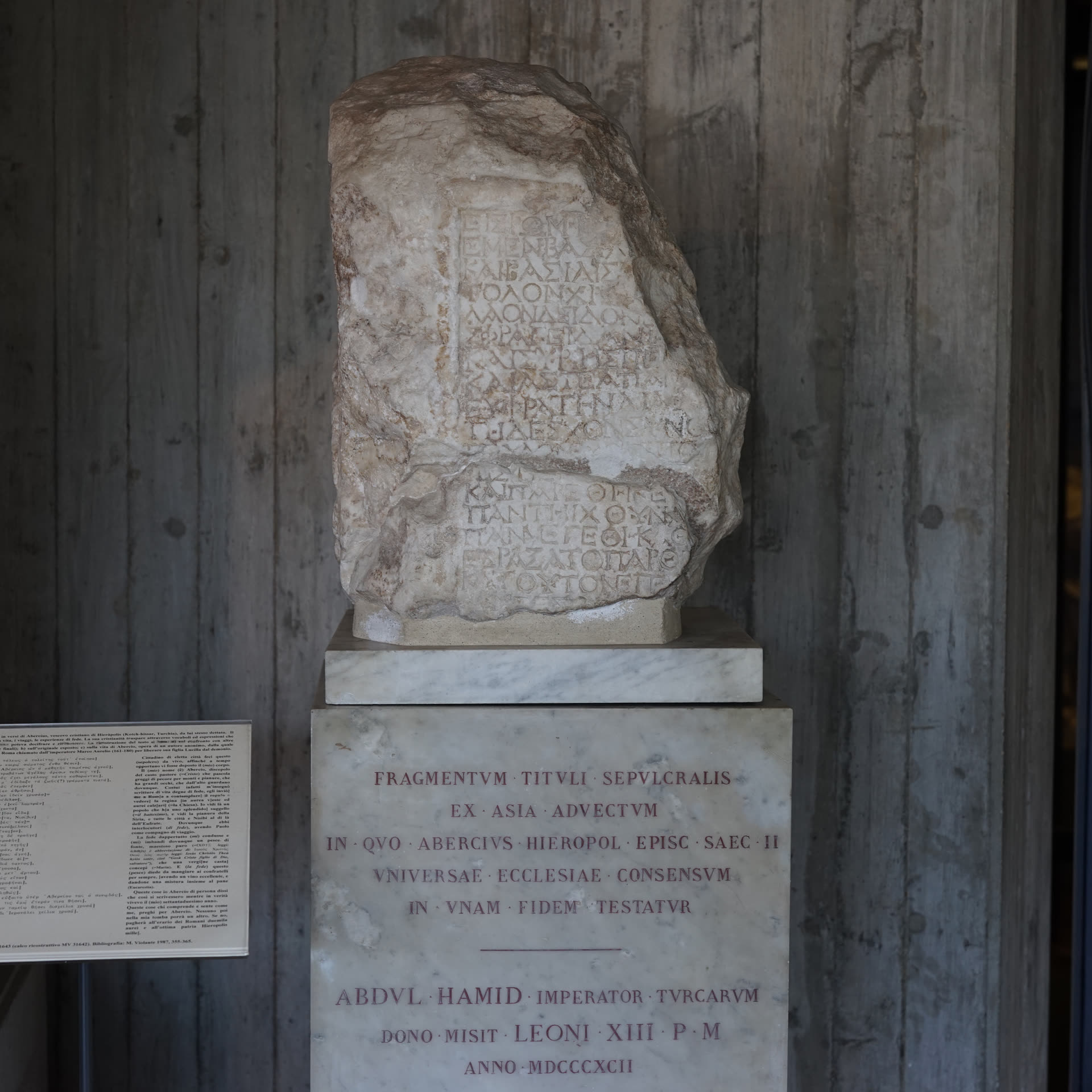
…and set before me for food the fish from the fountain, mighty and stainless (whom a pure virgin grasped), and gave this to friends to eat always, having good wine and giving the mixed cup with bread.
Abercius · funerary inscription, Hierapolis / Hieropolis, Phrygia · Lightfoot 1889, pp. 496–497 as cited
CIAN INTERPRETATIONThe twenty-two lines are reconstructed (the Life, the Alexander epitaph of 215/216, two stone fragments now in the Vatican).
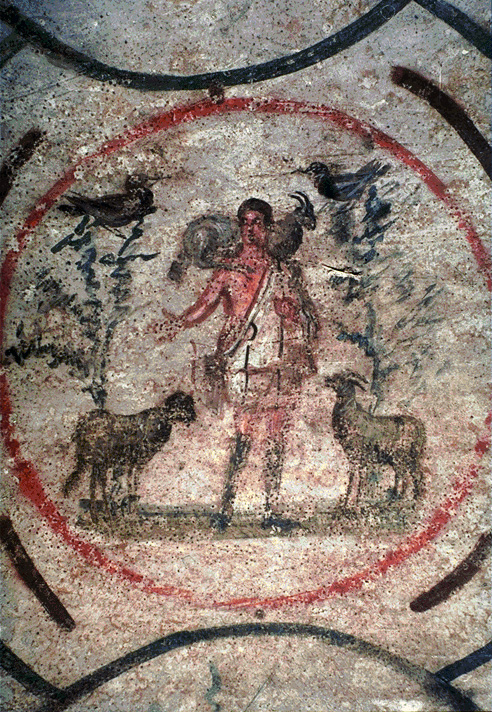
Abercius · funerary inscription fragments · Museo Pio Cristiano, Vatican · Fabrizio Garrisi, CC BY-SA 4.0. The original Phrygian stone, not the modern reconstruction beside it.Good Shepherd ceiling, Cubiculum of the Velatio, Catacomb of Priscilla, second half of the 3rd c. · Commons PD-Art. The era’s Shepherd image, not Abercius’s tomb.
A papyrus that still has notes
SOURCE
While we hymn Father and Son and Holy Spirit, let all the powers answer, “Amen, amen.”
P.Oxy. XV 1786 · anonymous · late 3rd c., Oxyrhynchus · Cosgrove 2011, after Grenfell & Hunt 1922
CIAN INTERPRETATIONBracketed words in the Greek are restorations. This is the only witness in the era with recoverable melody. We do not write “we can hear them sing.”
P.Oxy. XV 1786 · late 3rd c. · EES / Oxford · Commons PD-Art of the older online plate. Notation is visible.
The table
SOURCE
We thank thee, our Father, for the holy vine of David Thy servant, which You madest known to us through Jesus Thy Servant; to Thee be the glory for ever.
Didache 9 · anonymous · Roberts-Donaldson
SOURCE
…he taking them, gives praise and glory to the Father of the universe, through the name of the Son and of the Holy Ghost…
Justin Martyr · First Apology 65 · ANF, Roberts-Donaldson
CIAN INTERPRETATIONTwo tables, two named editions. Syria (inferred) and Rome (usual inference from Justin’s address). Not one reconstructed “early liturgy.”
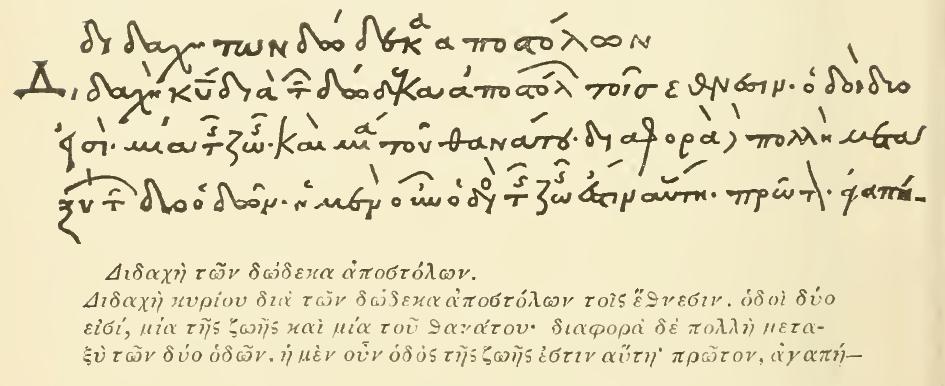
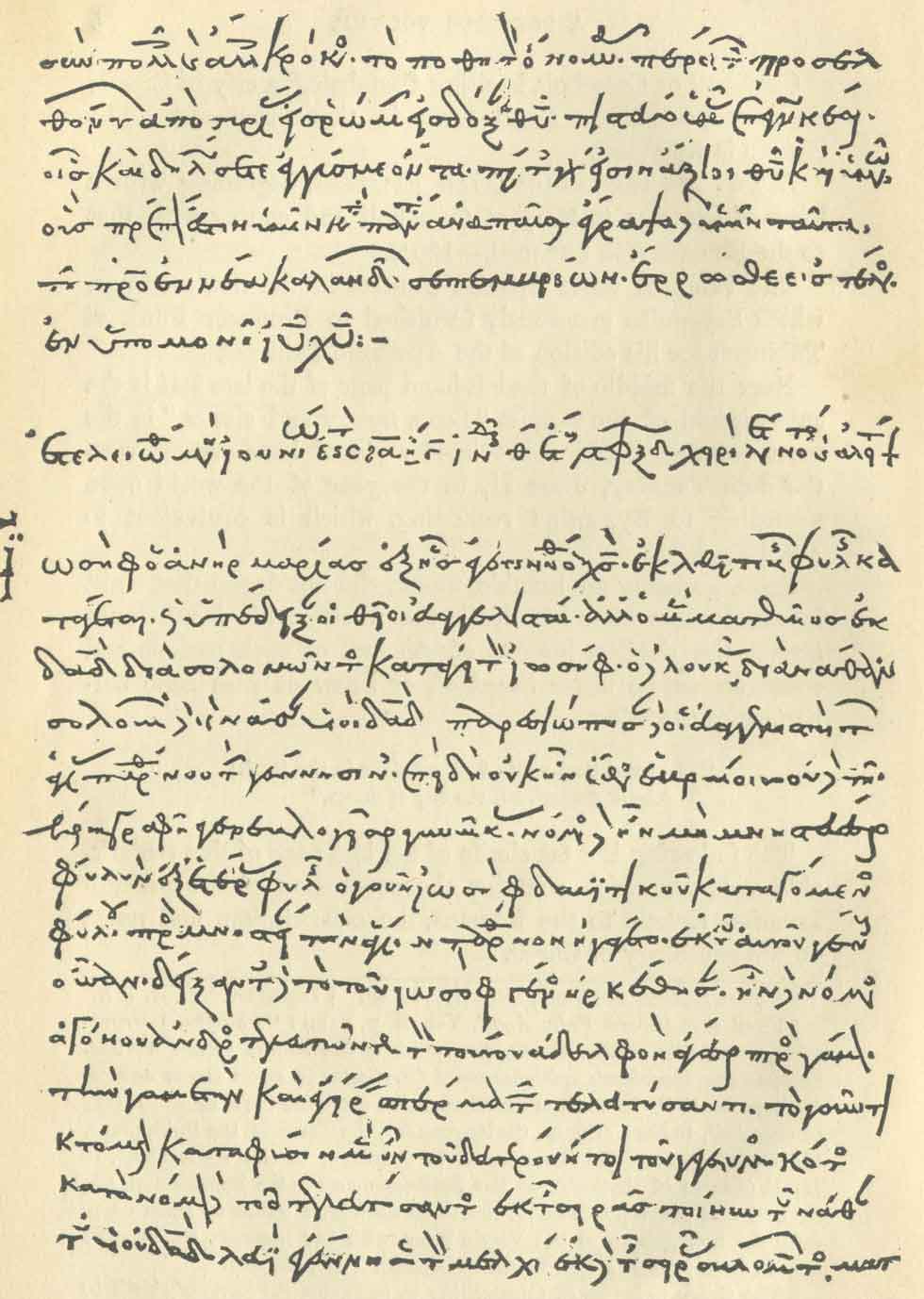
Didache · Schaff 1885 facsimile of the incipit of Jerusalem 54 (Bryennios, dated 1056) · PDLast page of the same unique complete codex. The manuscript is 11th c.; the text is late 1st / early 2nd. Schaff 1885 · PD.
Pascha
SOURCE
For the one who was born as Son, and led to slaughter as a lamb, and sacrificed as a sheep, and buried as a man, rose up from the dead as God, since he is by nature both God and man.
Melito of Sardis · On Pascha §§8–10 · Kerux 4.1 (May 1989)
SOURCE
The one who hung the earth in space, is himself hanged… The Lord is insulted, God has been murdered, the King of Israel has been destroyed by the right hand of Israel.
Melito · On Pascha §96 · Kerux 4.1 (May 1989)
Alexandria sings
SOURCE
Bridle of untamed colts, Wing of unwandering birds, sure Helm of babes, Shepherd of royal lambs, assemble Thy simple children to praise holily, to hymn guilelessly with innocent mouths, Christ the guide of children.
Clement of Alexandria · Hymn to Christ the Saviour, close of Paedagogus III · ANF vol. 2, the page’s “literal translation”
Someone who was not in the church
SOURCE
…on a stated day they had been accustomed to meet before daybreak and to recite a hymn among themselves to Christ, as though he were a god…
Pliny the Younger · Letters 10.96 · J. B. Firth 1900 · pagan-admin, Bithynia-Pontus
CIAN INTERPRETATIONHe heard a carmen. He did not write it down.
Quiet doors. Not a feed.
Magnificat
SOURCE
My soul magnifies the Lord, and my spirit rejoices in God my Savior, for he has regarded the low estate of his handmaiden.
Luke 1:46–48 · RSV · attributed in Luke to Mary
Nunc Dimittis
SOURCE
Lord, now lettest thou thy servant depart in peace, according to thy word; for mine eyes have seen thy salvation… a light for revelation to the Gentiles, and for glory to thy people Israel.
Luke 2:29–32 · RSV
1 Clement
SOURCE
For as God liveth, and the Lord Jesus Christ liveth, and the Holy Spirit, who are the faith and the hope of the elect…
The church in Rome to the church in Corinth · 1 Clement 58:2 · Lightfoot
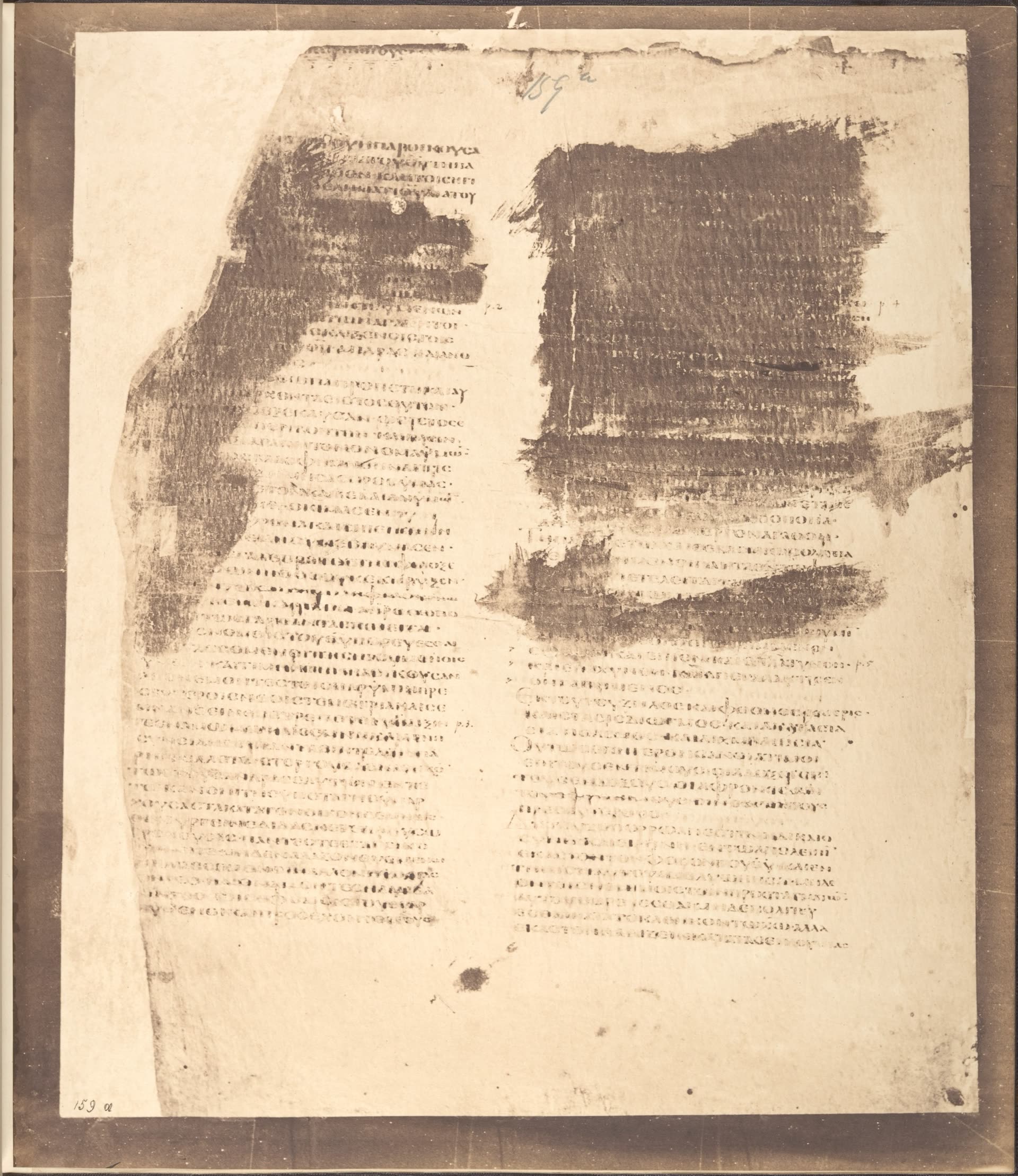
1 Clement in Codex Alexandrinus, 5th c. · Fenton 1856 · Met Open Access / PD. Not the Alexandrian hymn.
Irenaeus
SOURCE
Without the Spirit it is not possible to behold the Word of God, nor without the Son can any draw near to the Father…
Irenaeus · Demonstration of the Apostolic Preaching §7 · J. Armitage Robinson 1920 (from the Armenian; Greek lost)
Odes 19
SOURCE
The Son is the cup, and the Father is He who was milked; and the Holy Spirit is She who milked Him.
Odes of Solomon 19 · Charlesworth · anonymous; Solomon pseudepigraphic
Odes 41
SOURCE
The Son of the Most High appeared in the perfection of His Father. And light dawned from the Word that was before time in Him. The Messiah in truth is one.
Odes of Solomon 41:13–15 · Charlesworth · sister to 19
Tertullian
SOURCE
The more conscientious in prayer are accustomed to append to their prayers Alleluia and such manner of psalms, so that those who are present may respond with the endings of them.
Tertullian · De Oratione 27 · Ernest Evans, 1953, printed page |37 · African Latin
Listen
Recordings from the 3rd century
No recordings from the 3rd century yet
Other centuries in this era may have recordings available.
First-century Judea and the early Christian communities · Levant
The songs preserved in the Gospels and Epistles — Magnificat, Benedictus, Nunc Dimittis, and the hymnic passages of Philippians 2 and Colossians 1 — form the earliest layer of Christian song.